The figures
At the 2021 Census, 33% of the district's 209,867 households lived in a terraced house, against 23% across England (ONS). The share is highest in the inner wards: Bradford Moor 59.5%, Little Horton 55.3%, Manningham 53.7% and Toller 49.1%.
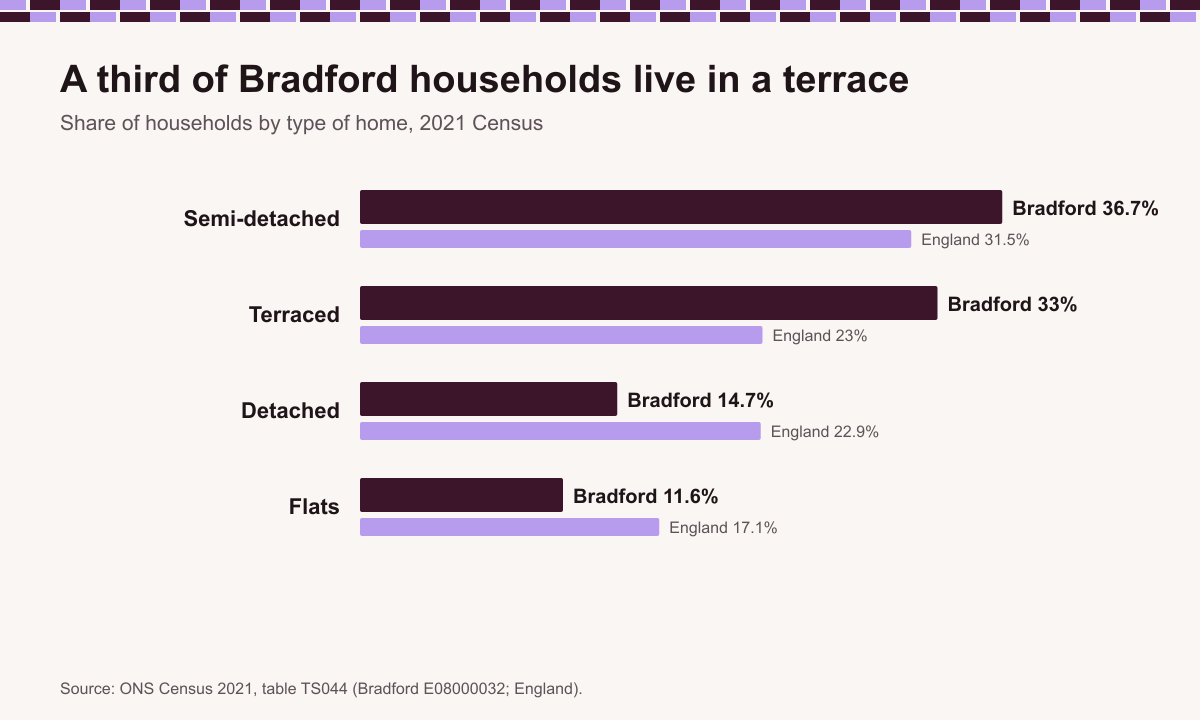
Age goes with it. 29.5% of the 225,120 properties on the council tax list were built before 1919 and 23.4% before 1900 (VOA 2026), and only 21.2% of terraced homes with an EPC reach band C (ONS). An average terraced house sold for £156,116 in August 2026 (HM Land Registry).
| Slope faces | kWh a year per kW | 2.5 kW slope (our arithmetic) |
|---|---|---|
| South | 934 | 2,335 kWh |
| South-east | 882 | 2,205 kWh |
| South-west | 875 | 2,188 kWh |
| East | 742 | 1,855 kWh |
| West | 735 | 1,838 kWh |
| North | 505 | 1,263 kWh |
What a terrace roof offers
A through-terrace has rooms front and back and a pitched roof running along the row, so the house owns a front slope and a back slope facing opposite ways. If the street runs east to west, one of those slopes faces roughly south and is the obvious choice; if it runs north to south, both slopes face east or west, and in the city centre those make 742 and 735 kWh per kW a year against 934 for south (PVGIS 5.3). Panels can go on both, which spreads the output across the day.
What limits a terrace is space. Chimney stacks often sit on the party walls at each end of the roof, back extensions take part of the rear slope, and dormers and roof windows break up the rest. Each one also casts shade at some point in the day. That tends to mean smaller systems, sometimes with optimisers so that one shaded panel does not pull down the others, and a smaller system usually costs more per kW because scaffolding and the inverter are spread over fewer panels (costs). Use the estimator to see what a smaller system on your slope would make.
Stone and slate roofs
Many older houses in the district are built of stone, with stone or slate roofs. Neither stops solar, but both need care. Stone slates are heavy and break when walked on carelessly, and the fixings that hold the panel rails have to go through the roof covering into the rafters. Ask each installer how they fix to your kind of roof, how they deal with broken slates, and whether a roofer should look at the roof first. If the roof needs repairs within a few years, doing them before the panels go on avoids paying for scaffolding twice.
Dormers and the Article 4 directions
Bradford Council lists Article 4 directions in Little Horton and Manningham, two of the most terraced parts of the city, and in Apsley Crescent. They remove permitted development rights for dormer windows and for painting stone; none of them mentions solar panels (Bradford Council). Roof panels within the national limits are normally permitted development, but in a conservation area there are extra limits on walls and balconies facing a road. If your terrace is in a conservation area or the panels would sit beside a dormer, ask the council first. See planning, Saltaire and conservation areas.
Terraces and the help on offer
Because only 21.2% of Bradford terraces reach EPC band C (ONS), most of them meet the EPC test of the Warm Homes: Local Grant, which looks for homes at band D to G. The household still has to qualify, on a low-income postcode, a means-tested benefit or an income under £36,000, and the council says it has delivered solar PV and battery storage under that grant (Bradford Council). Better Homes Bradford separately offers solar with battery storage, after a survey, to privately-owned and privately-rented households in qualifying areas; the scheme confirms whether an address qualifies (Bradford Council). See help with the cost.
Whatever pays for it, a small terrace system follows the seasons closely: a 2.5 kW south slope in the city centre makes about 273 kWh in June and 78 kWh in December at the best angle (our arithmetic from PVGIS 5.3). Set that against what the household uses in each season before deciding on a battery: batteries.
What to ask an installer about a terrace
- Which slope, and what will each slope make in a year? Ask for both if both are used.
- How many panels fit around the stacks, extension and any dormer, and what shades them?
- Are optimisers included, and why or why not?
- How will the rails be fixed to this roof covering, and who replaces broken slates?
- Where will scaffolding stand, and does it need the pavement or a neighbour's yard?
- How will the cable run from the roof to the meter: inside, or down the front or back wall, and how is it fixed to the stone?
Then check the firm itself: choosing an installer in Bradford.