The figures
Of the 225,120 properties on the district's council tax list, 23.4% were built before 1900 and 29.5% before 1919; 16.4% date from between the wars and 16% from 2000 onwards (VOA 2026). The energy ratings follow the age closely.
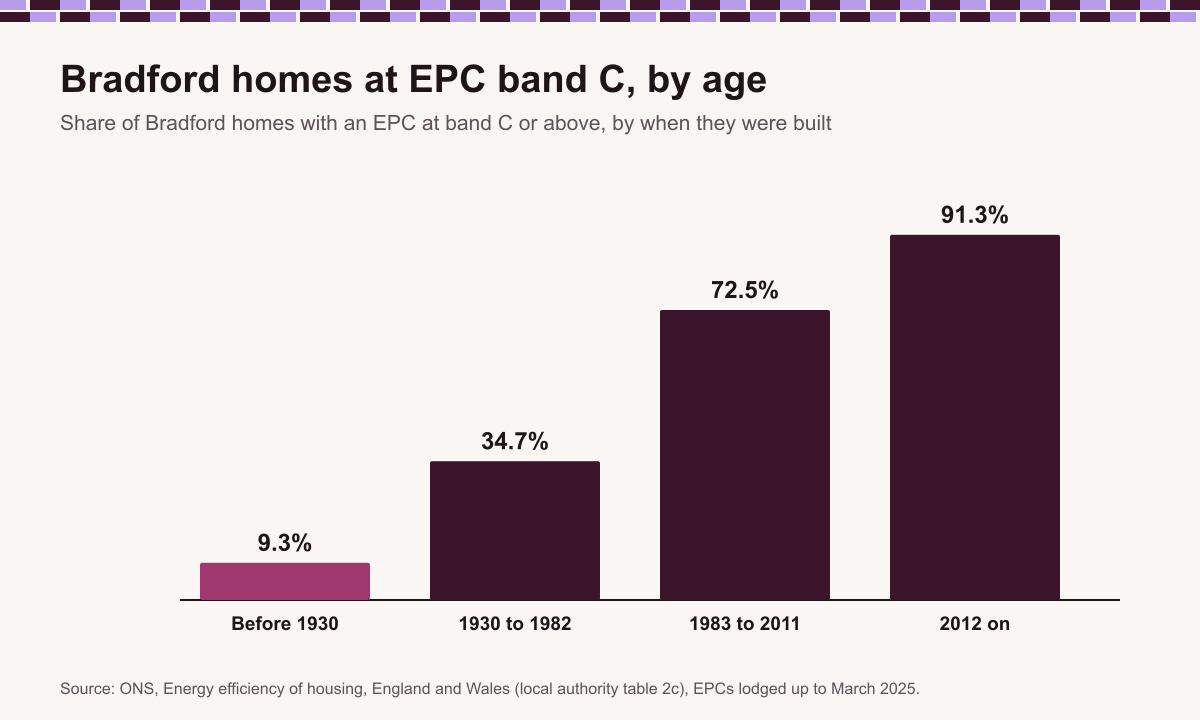
| Group | Band C or above |
|---|---|
| Built before 1930 | 9.3% |
| 1930 to 1982 | 34.7% |
| 1983 to 2011 | 72.5% |
| 2012 or later | 91.3% |
| Terraced homes | 21.2% |
| Semi-detached | 36.1% |
| Detached | 46.8% |
| Flats | 67.1% |
| All Bradford homes | 37.3% (England 53.3%) |
The median energy score of a Bradford home built before 1930 is 56, against 65 for all the district's homes (ONS). Flats do best because they share walls, floors and ceilings with warm neighbours; terraces, despite their shared side walls, do worst of the house types, which probably reflects how old so many of them are.
What panels do for a rating
Solar panels make the same electricity on an old roof as on a new one: in the city centre a south-facing roof at 35° gives about 934 kWh a year per kW (PVGIS 5.3). The energy assessment counts electricity generated on the premises, so panels usually raise a rating. How far depends on the size of the system and on everything else in the house, so ask an energy assessor rather than relying on a seller's promise of a particular band.
What panels do not do is keep heat in. In a solid-walled stone house the rooms stay as cold as before; the panels reduce the electricity bought from the grid, mostly in summer. Use the estimator to see the monthly shape for your place.
The order of work
For comfort, the usual order is to stop the heat escaping first: loft and attic rooms, draughts, then walls and floors where practical, then heating, with panels at any point that suits the roof and the budget. Panels do not have to wait for insulation, and roof work is a natural moment for both: scaffolding put up for one job can serve the other. If you plan a new roof covering in the next few years, do it before the panels go on. A retrofit assessment, which the Warm Homes: Local Grant uses, sets out an order for a particular house.
Two Bradford houses compared
Take a stone terrace built before 1930 near the city centre and a 1990s semi up at Idle. On the roof they are almost equal: a south-facing kW makes about 934 kWh a year in the city centre and 941 at Idle (PVGIS 5.3). On the certificate they are far apart: 9.3% of Bradford homes built before 1930 reach band C, against 72.5% of those built between 1983 and 2011 (ONS). So the panels would do much the same job on either roof; what differs is everything else the older house may need, and which help its household can reach. The estimator shows both sides for any era, type and place.
Questions to settle on an older house
- Roof structure. Will the rafters and battens take the rails, and does the covering need work first? Re-roofing after the panels are on means lifting them again.
- Chimney stacks. Old stacks on the party walls often need pointing or rebuilding; doing it before the panels go up saves a second scaffold.
- Attic rooms. Better Homes Bradford's attic room insulation needs a fixed staircase and a window (Bradford Council); where a room qualifies, ask whether it should come before panels on the same slope.
- Wiring. An old consumer unit may need replacing before an inverter can be connected; ask for it as its own line on the quote.
- Moisture. Insulating a solid stone wall without thinking about how it breathes can trap damp; ask whoever surveys the house how moisture and ventilation will be handled before any insulation is fitted.
None of these are reasons to rule panels out. They are reasons to ask for a survey that looks at the whole roof and the house's wiring, and to compare quotes on that basis: see stone terraces and what solar costs.
Help for older homes
The Warm Homes: Local Grant is aimed at homes at EPC D to G, where the household qualifies through a low-income postcode, a means-tested benefit or an income under £36,000; measures follow a retrofit assessment and national caps are £16,600 for each part (DESNZ). Bradford Council has delivered solar PV and battery storage under it (Bradford Council). In 2024, 12.2% of the district's households, about 26,829, were in fuel poverty, against 9.9% in England (DESNZ). See help with the cost for every route and what solar costs for the prices.
Listed homes
Historic England counts 2,290 listed entries in the district, 23 of them at grade I (Historic England). In Saltaire, every property in the Article 4 area was listed in 1984 (Bradford Council). Panels on a listed building, and insulation that alters its fabric, may need listed building consent; ask the council before planning either. See planning, Saltaire and conservation areas.